Wurzelwerk
A visual board for clans and families: people, relationships and centuries of history on one canvas.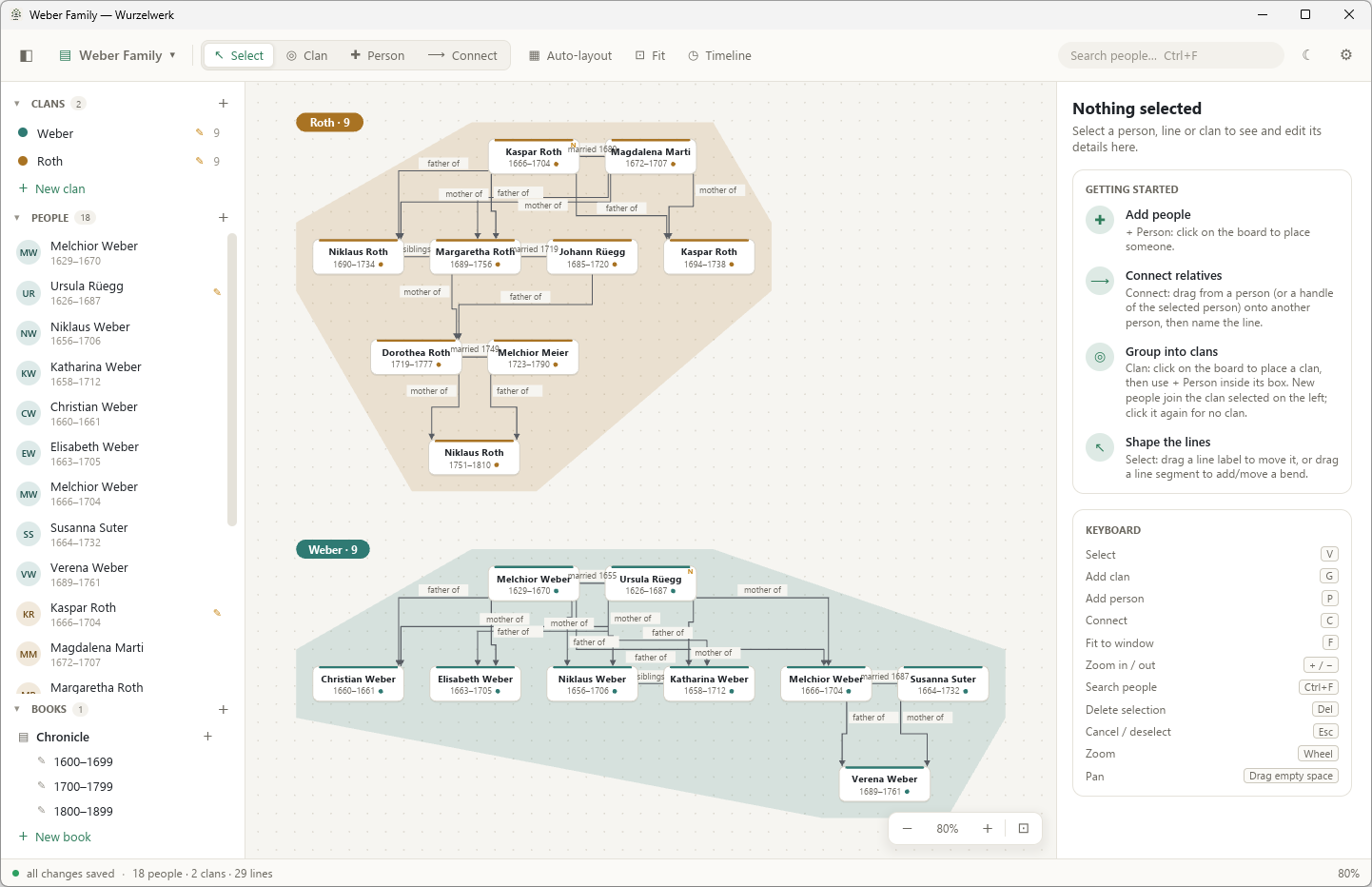
Wurzelwerk (“root system” in German) is a desktop app for mapping families and clans. Instead of filling in forms, you place people on a large board, group them into clans and draw the lines between them. A timeline then lets you watch the family grow and change over the years.
The board
- People are cards with a name, birth and death year, notes and attached files such as photos or documents.
- Clans are coloured areas around their members. A person can belong to several clans, for example through marriage.
- Lines connect two people and carry a name.
married,siblingsandpartnerdraw a plain line,parents of,father ofandmother ofan arrow, and anything else, such asgodfather of, a dashed arrow. - Books hold longer text, such as a family chronicle with one page per century.
Lines are routed automatically around cards with as few bends as possible, and their labels are placed where they don’t overlap anything. You can still drag any segment, corner or label to shape a line by hand.
Timeline
Press T to open a year slider under the board. Everyone alive during the selected range is shown: people appear in their birth year and fade out after they died. Press Space to play it and watch generations come and go. Lines with a year, such as married 1789, appear from that year on.
Auto-layout
One click arranges the whole board: partners side by side, children in the generation below, parents centred over their children and as few crossing lines as possible. Each clan is packed into a compact group.
Built for large families
Wurzelwerk stays smooth with thousands of people on one board. It draws only what is visible, caches line routes and switches to simpler shapes when you zoom far out. You can try this with the built-in demo, which generates up to 10,000 people.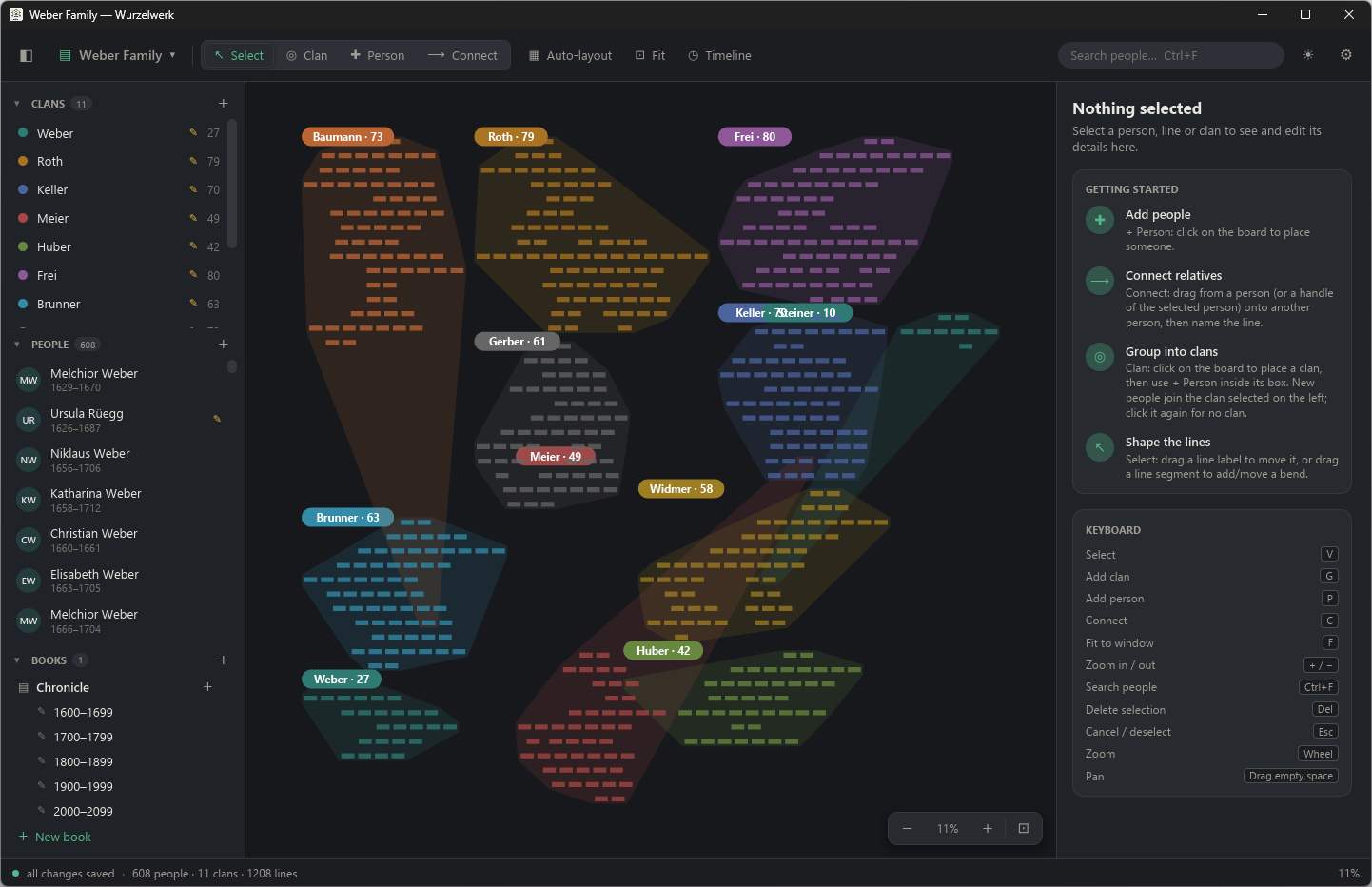
Your data
Each family lives in its own workspace folder: one database file plus the attached files. You can keep several workspaces and switch between them. The example workspace on the welcome screen creates eleven clans with about 600 people from 1620 to today, so you can explore before entering your own family.
Getting started
Download Wurzelwerk from the releases page, or build it from source:
cargo run --releaseThe interface is available in English and German and follows your system’s language and light or dark setting.
License
Wurzelwerk is written in Rust with the iced GUI toolkit and licensed under MIT or Apache 2.0, at your option. The embedded database it uses, RedDB, has its own licence (BUSL-1.1).